
Minimally Invasive Surgery — The Villages, FL
What Is
Arthroscopic Surgery?
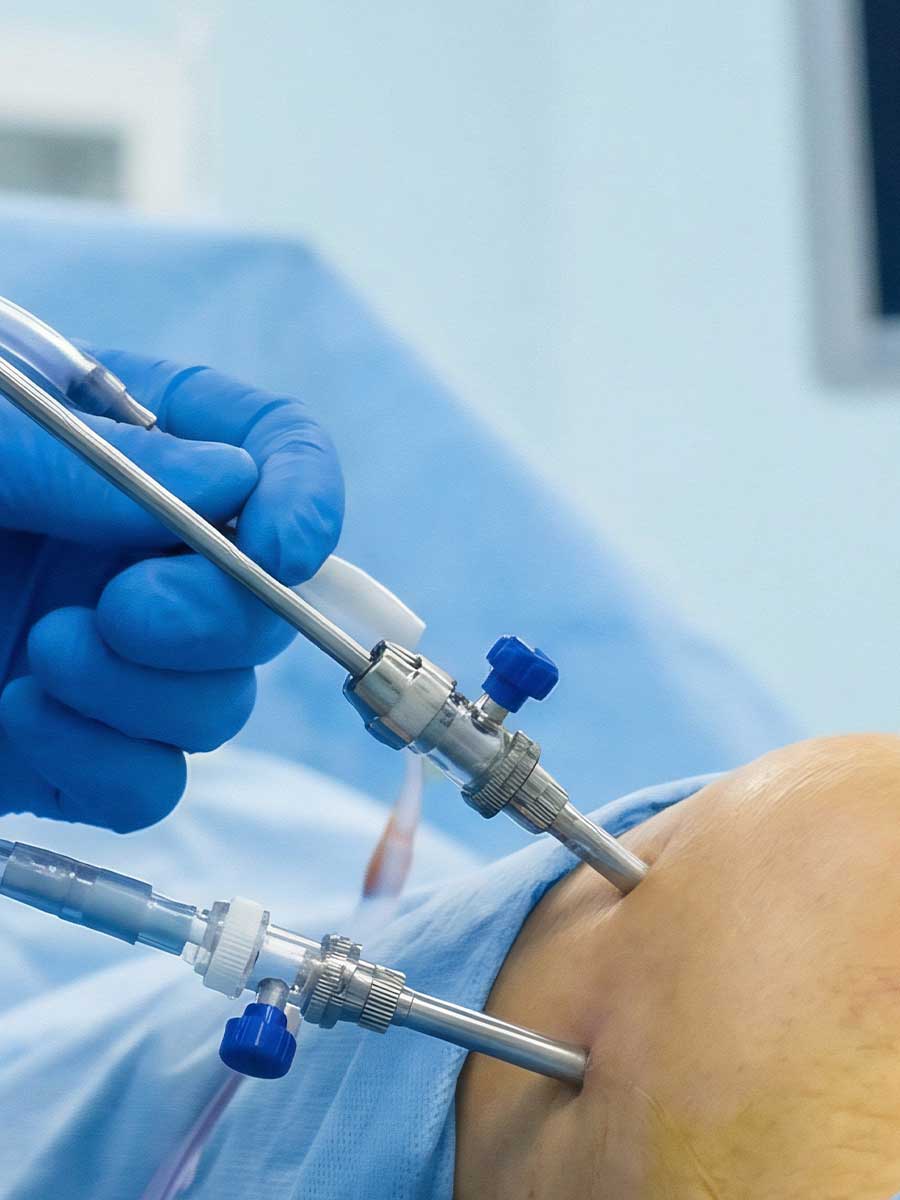
Arthroscopic surgery is a minimally invasive surgical technique that allows Dr. Cook to diagnose and treat joint problems through very small incisions. A tiny camera called an arthroscope is inserted into the joint, transmitting magnified images to a monitor — giving the surgeon a clear, detailed view without the need for a large surgical opening.
Because the incisions are so small, arthroscopic surgery typically results in less pain, less scarring, a lower risk of complications, and a significantly faster recovery compared to traditional open surgery. Many procedures are performed on an outpatient basis — meaning you go home the same day.
Dr. Cook performs arthroscopic procedures on the shoulder, knee, and other joints — using the latest techniques to achieve the best possible outcomes for his patients throughout The Villages and surrounding communities.
what to expect
Your Arthroscopic Surgery Journey
Step 1 — Consultation & Imaging
Dr. Cook evaluates your symptoms, reviews on-site imaging, and discusses your goals. If arthroscopic surgery is the right path, he’ll explain exactly what to expect and answer all your questions.
The AOI Arthroscopy Advantage
Less Invasive.
More Life.
When surgical treatment is needed, arthroscopy offers meaningful advantages over traditional open procedures — smaller incisions, less post-operative pain, reduced scarring, lower complication risk, and significantly faster return to activity.
At AOI, arthroscopic surgery is just one part of a complete care continuum. On-site imaging before your procedure, Dr. Cook’s precision surgical technique, and our in-house physical therapy team working together after — your entire journey is managed under one roof, by one coordinated team.
Most patients go home the same day and begin rehabilitation sooner — getting back to daily activities, work, and recreational sport more quickly than traditional surgical approaches allow.



REGENETEN® Bioinductive Implant
For patients with rotator cuff tendon tears not yet requiring full shoulder replacement, our physicians offer the REGENETEN® Bioinductive Implant — an innovative, minimally invasive technology from Smith+Nephew.
Rather than simply reattaching tissue, this approach works with your body’s natural healing process to stimulate the growth of new tendinous tissue at the injury site. Delivered arthroscopically through a small incision and fully absorbed by the body within approximately six months.
REGENETEN◊ Bioinductive Implant
REGENETEN◊ Bioinductive Implant
Your Physician is pioneering the use of a breakthrough technology designed for people suffering from rotator cuff tendon tears in the shoulder joint. The REGENETEN Bioinductive Implant, an innovative, minimally invasive solution, goes beyond traditional surgery to help the tendon heal through the induction of new tendinous tissue growth1,2,3.
A new approach - REGENETEN Bioinductive Implant
Until now, surgeons have focused on addressing the mechanics of the shoulder when repairing a rotator cuff injury, but had limited options to address the biology of healing. Traditional rotator cuff repair procedures involve suturing tendon to bone are associated with potentially long rehabilitation and substantial lifestyle interruption. As a result, many people choose to forego surgery until their pain is severe and everyday tasks are affected. However, as rotator cuff disease progresses, it can become increasingly difficult for your surgeon to repair and small tears can grow in severity and size over time 4,5,6.
The REGENETEN Bioinductive Implant is an innovative technology designed to address the treatment of rotator cuff disease
The REGENETEN Bioinductive Implant offers a new solution that supports the body's natural healing response to facilitate new tissue growth and potentially disrupt disease progression 1,2,7-9 by providing a framework for tissue growth.
What is it?
The technology includes a collagen based bioinductive implant about the size of a postage stamp. This implant is delivered arthroscopically through a small incision over the location of your rotator cuff tendon injury. Your physician will secure it in place with small anchors. 
How does it work?
Progression of healing
The implant is placed on top of the rotator cuff After implantation, the REGENETEN Bioinductive implant creates an environment that is conducive to healing 1,2,7 and the proprietary composition facilitates the formation of new tissue 1,2,7,10.
The implant induces new tissue growth, increasing tendon thickness 1,2,3.
New tissue allows tendon to restore its natural attachment points in the body3 and is indistinguishable from native tendon at 3 months 1,2,11.
New tissue integrates and remodels into the healing tendon 2,7,11 .
Tissue strength comes from the induced tissue, not the implant, which has been shown to be completed absorbed within six months 7,11, *.
How does the REGENETEN Bioinductive Implant benefit you?
No matter where you are in the progression of rotator cuff disease, the REGENETEN Bioinductive Implant has shown consistent healing of rotator cuff tears in both partial and full thickness tears 1,2,8,12.
- Preliminary evidence indicates a reduction in re-tear rates compared to the standard of care in patients with full thickness tears 3,13
- No tear progression was observed by MRI in any patients at 24 months in a study on partial thickness tears (n=13) 1
- Clinically meaningful improvements in pain and function scores at one year compared to pre-operation values 14,15
- Excellent safety profile shows there have been no serious implant-related adverse events reported in the published literature 1-3,7,12
References
- Bokor DJ, Sonnabend D, Deady L, et al. Evidence of healing of partial-thickness rotator cuff tears following arthroscopic augmentation with a collagen implant: a 2-year MRI follow-up. Muscles, Ligaments Tendons J 2016;6(1):16-25.
- Schlegel TF, Abrams JS, Bushnell BD, Brock JL, Ho CP. Radiologic and clinical evaluation of a bioabsorbable collagen implant to treat partial-thickness tears: a prospective multicenter study. J Shoulder Elbow Surg. 2018 27(2):242-251.
- Bokor DJ, Sonnabend D, Deady L, et al. Preliminary investigation of a biological augmentation of rotator cuff repairs using a collagen implant: a 2-year MRI follow-up. Muscles, Ligaments Tendons J 2015;5(3):144-150.
- Henry P, Wasserstein D, Park S, et al. Arthroscopic repair for chronic massive rotator cuff tears: A systematic review. Arthroscopy. 2015;31(12):2472-80.
- Bishop J, Klepps S, Lo IK, Bird J, Gladstone JN, Flatow EL. Cuff integrity after arthroscopic versus open rotator cuff repair: A prospective study. J Shoulder Elbow Surg. 2006;15(3):290-299.
- Heuberer PR, Smolen D, Pauzenberger L et al. Longitudinal long-term magnetic resonance imaging and clinical follow-up after single-row arthroscopic rotator cuff repair. Am J Sports Med. 2017;45(6):1283-1288.
- Van Kampen C, Arnoczky S, et al. Tissue-engineered augmentation of a rotator cuff tendon using a reconstituted collagen scaffold: a histological evaluation in sheep. Muscles, Ligaments Tendons J. 2013;3(3):229-235.
- Bokor DJ, Sonnabend DH, et al. healing of partial thickness rotator cuff tears following arthroscopic augmentation with a highly porous collagen implant: a 5-year clinical and MRI follow-up. Muscles, Ligaments Tendons J 2019;9(3):338-347.
- McElvany MD, McGoldrick, et al. Rotator cuff repair: published evidence on factors associated with repair integrity and clinical outcome. Am J Sports Med. 2015;43(2)491-500.
- Smith + Nephew 2020 REGENETEN Collagen Implant Physical Characteristics. Internal Report
- Arnoczky SP, Bishai SK, Schofield B, et al. Histologic Evaluation of Biopsy Specimens Obtained After Rotator Cuff Repair Augmented With a Highly Porous Collagen Implant. Arthroscopy. 2017;33(2):278-283.
- Thon SG, O'Malley L, O'Brien MJ, Savoie FH. Evaluation of Healing Rates and Safety With a Bioinductive Collagen Patch for Large and Massive Rotator Cuff Tears: 2-Year Safety and Clinical Outcomes. Am J Sports Med 2019;47(8):1901-1908.
- Smith and Nephew 2019. An overview of the outcomes associated with the standard of care for the surgical treatment of rotator cuff tears. Internal Report EO/SPM/REGENETEN/005/v1
- McIntyre L, Bishai SK, et al. Patient-reported outcomes following use of a bioabsorbable collagen implant to treat partial and full-thickness rotator cuff tears. Arthroscopy. 201935(8):2262-2271.
- Cvetanovich GL, Gowd AK, et al. Establishing clinically significant outcome after arthroscopic rotator cuff repair. J Shoulder Elbow Surg. 2019;28(5):939-948.
*on human biopsy (n=1) and in-vivo sampling
All materials copyright © 2024 Smith & Nephew, All Rights Reserved.