Trauma & Fracture Management

Expert Fracture Care In The Villages, FL

Prompt, precise orthopedic management of acute fractures and musculoskeletal injuries — from same-day imaging through full recovery and return to activity.

Fracture Care — The Villages, FL

Getting It Right
From the Start.

A fracture — whether from a fall, an accident, or a sports injury — requires prompt, expert orthopedic management. How a fracture is treated in the first days and weeks has a profound impact on healing quality, long-term function, and return to activity.

At AOI, Dr. Cook provides comprehensive fracture management — from initial evaluation and on-site imaging to definitive treatment, whether that means casting, splinting, or surgical fixation. Same-day X-rays mean you get answers during your visit, without waiting for an outside imaging appointment.

After your fracture is stabilized and healing is confirmed, our in-house physical therapy team guides your return to strength and function — giving you a continuous, coordinated recovery from injury to full activity under one roof.
What We Treat

Fracture & Trauma Types

Upper Extremity Fractures

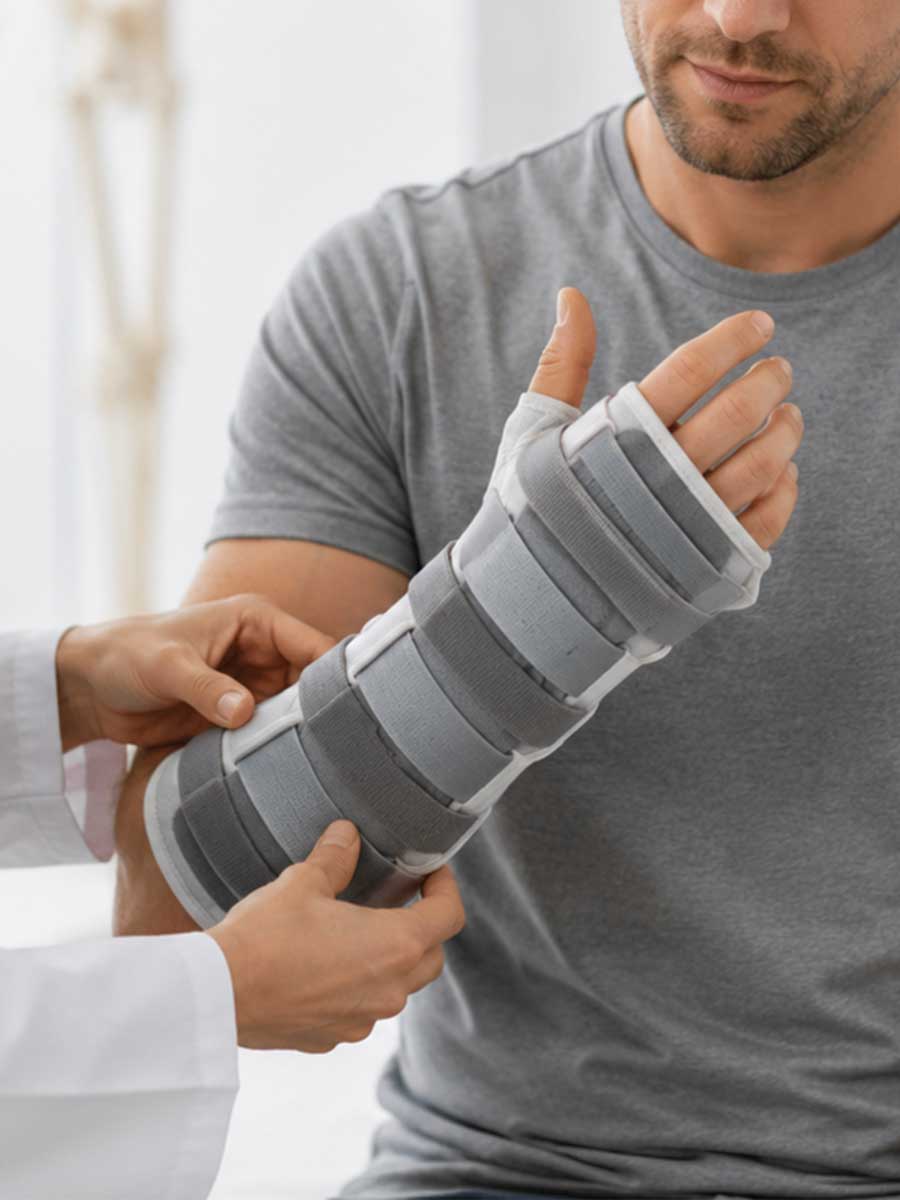
Wrist, forearm, elbow, and humerus fractures — among the most common from falls. Treated with casting, splinting, or surgical fixation depending on fracture pattern and displacement.

Lower Extremity Fractures

Ankle, tibia, femur, and foot fractures requiring accurate alignment and stable fixation to ensure proper healing and full return to weight-bearing and walking.

Stress Fractures

Hairline cracks caused by repetitive loading — common in active individuals. Early identification and activity modification are critical to prevent progression to a complete fracture.

Periarticular Fractures

Fractures around the shoulder, elbow, wrist, knee, or ankle joints often require specialized management to preserve joint function alongside bone healing.

Fracture Non-Union

Bones that fail to heal properly after initial treatment may require revision — including bone grafting or internal fixation — to achieve solid union and restore full function.

Combined Soft Tissue Injuries

Many fractures occur alongside ligament, tendon, or neurovascular injuries. Comprehensive evaluation ensures all components of a traumatic injury are identified and properly addressed.

How Fracture Care Works at AOI

From Injury to Full Recovery

Step 1 — Evaluation & Imaging

On-site X-rays confirm the fracture type, location, and alignment during your visit — giving Dr. Cook everything needed to determine the best treatment approach without additional appointments.

Step 2 — Stabilization & Treatment

Depending on fracture severity, treatment may include casting, splinting, or surgical fixation using plates, screws, or rods to hold the bone in proper alignment while healing occurs.

Step 3 — Rehabilitation & Return

Once healing is confirmed on follow-up imaging, AOI’s in-house physical therapy team guides your return to full strength and activity — tailored to your specific fracture and your goals.

Surgical & Non-Surgical Fracture Care

The Right Treatment.
Every Fracture.

Not every fracture requires surgery. Many heal very well with casting or splinting when bone fragments are adequately aligned. Dr. Cook always recommends the most conservative approach that gives your bone the best chance to heal correctly while preserving as much function as possible.

When surgical treatment is needed, AOI offers a full range of options — including open reduction and internal fixation (ORIF) using plates and screws, intramedullary nailing for long bone fractures, and specialized approaches for complex periarticular injuries.

Throughout your recovery, regular follow-up imaging tracks healing progress. Our in-house physical therapy team begins rehabilitation at the right time — ensuring you regain full strength and return to activity with confidence.

Frequently Asked Questions

Have more questions? Our team is here to help you understand your options and make the right decision for your health.

It is often impossible to tell without imaging. Signs suggesting a fracture include significant swelling, visible deformity, point tenderness directly over the bone, and inability to bear weight or use the limb. When in doubt, come in — a quick X-ray gives a definitive answer.

No. Many fractures heal well with casting or splinting if the bones are properly aligned. Surgery is recommended when fragments are significantly displaced, when multiple pieces are involved, or when joint function is at risk without precise fixation.

Healing time varies widely by fracture location, severity, patient age, and overall health. Minor fractures may heal in 4–6 weeks. Complex fractures or surgical cases may take 3–6 months for full bone consolidation. Regular follow-up X-rays confirm progress.

For many fractures — especially those near joints or requiring surgery — physical therapy is an important part of full recovery. Our in-house PT team begins rehabilitation at the appropriate time to restore strength, range of motion, and function.

Yes — please bring any imaging you have or have it sent to AOI before your appointment. Dr. Cook will review all available images. In some cases, repeat or additional imaging may be needed for a complete orthopedic evaluation.
Stress fractures are hairline cracks caused by repetitive loading rather than a single traumatic event. They’re common in runners, cyclists, and active older adults. Treatment typically involves activity modification and protected weight-bearing — surgery is rarely needed if caught early.